
Ensippification
All that data is not gold

“The interface of social media tends to capture positive reactions in the first moment of exposure.” - C. Thi Nguyen, The Score
Many of the characters who populate the pages of Malcolm Gladwell’s Blink have skills that border on the miraculous or the magical. Tennis coach Vic Braden is able to tell when a player, any player, is about to double-fault on a serve. “‘For a while it got so bad that I got scared,’ Braden says. ‘It literally scared me. I was getting twenty out of twenty right, and we’re talking about guys who almost never double-fault’” (48). John Gottman is able to watch an hour of conversation between a husband and wife and “predict with 95 percent accuracy whether that couple will still be married fifteen years later” (21). These folks, and many others in various domains, are able to leverage years of experience and expertise to form what Gladwell describes as uncannily accurate “snap judgments.” They’re tapping into what the book’s subtitle declares is “the power of thinking without thinking.”
That subtitle is a little misleading, however. These examples are often of people who have actually done a great deal of observation, analysis, and pattern recognition. They’ve thought plenty, to the extent that they become adept at applying that knowledge and expertise synecdochally1. They’re able to isolate those parts that scale up to a predictable whole, and base an evaluation of the whole on the part. They’re able to act with limited information, even in high pressure situations. At one point, in a discussion about improv comedy, Gladwell uses the analogy of basketball:
Basketball is an intricate, high-speed game filled with split-second, spontaneous decisions. But that spontaneity is possible only when everyone first engages in hours of highly repetitive and structured practice—perfecting their shooting, dribbling, and passing and running plays over and over again—and agrees to play a carefully defined role on the court (113).
What we perceive as snap judgments, then, are often actually honed through extensive practice and preparation. That’s not to say that some of Gladwell’s examples aren’t more intuitive and improvisational than others, but it does underline the extent to which we valorize the snap judgment, the ability to “think without thinking2.”
There are downsides to snap judgments, which Gladwell considers as well. The degree to which our trained experience can include prejudices and stereotypes can systematically lock those attitudes into our behavior, for example. But the example that I mentioned in my review of Nguyen is one that I wanted to tease out further here, and that’s the sip test. Gladwell writes about the Pepsi Challenge, which was part of Pepsi’s campaign in the late 1970s and early 1980s to erode Coke’s market dominance. Participants were given small, unlabeled samples of each cola, encouraged to drink them, and to choose the one they preferred. A surprising number of tasters (57%) chose Pepsi, which threw Coke executives into a tizzy. You’ll have to be a certain age to remember the disaster that ensued: in response to the Pepsi Challenge, they released “New Coke,” which did manage to outperform Pepsi in subsequent sip tests, but otherwise went over like a fart in church.

The issue, as Gladwell explains, is that sip tests (aka CLT, or central location tests) are designed to measure one very specific thing, a decontextualized first impression. The problem isn’t the sip test per se, but the idea that one’s preference in such a test automatically scales, that we can extrapolate it to general preference. “Pepsi,” he observes, “is a drink built to shine in a sip test” (159). The flavor in that initial sip “tends to dissipate over the course of an entire can,” and that’s to say nothing of how persistent the carbonization might be in an open container, how the drink might complement a meal, where (outside of grocery stores) consumers are ever offered a choice3, etc. The Pepsi Challenge extrapolated a whole (cola preference) from a part (an initial blind sip) that rewards qualities (sweetness, e.g.) that made Pepsi appear to be the superior product, and struck panic in the heart of the C-suite at Coke4.
Ensippification
I want to offer, somewhat tongue-in-cheek, the term ensippification for this process. I’m intentionally invoking the vibes of Cory Doctorow’s enshittification here, because there’s a parallel in the way that Coke executives deliberately devalued their product to accomplish specific corporate ends. But there’s a piece of this that’s resonant with Nguyen’s book as well, in the sense that those executives allowed themselves to fall prey to a clear instance of value capture:
Value capture occurs when an agent’s values are rich and subtle — or developing in that direction. The agent enters a social environment that presents simplified — typically quantified — versions of those values; and those simplified articulations come to dominate their practical reasoning.
Considering the marketing push behind the Pepsi Challenge, perhaps it’s not surprising that the Coke execs took notice, but they were persuaded by their competitors’ advertising to an astonishing degree. Their willingness to believe in the sip test, to the exclusion of any other metric, and to blow up a decades-old product in response suggests that their practical reasoning had certainly been “dominated.” They voluntarily submitted themselves to the downside of Goodhart’s Law; New Coke was an excellent demonstration of what can happen when you turn a metric into a target.
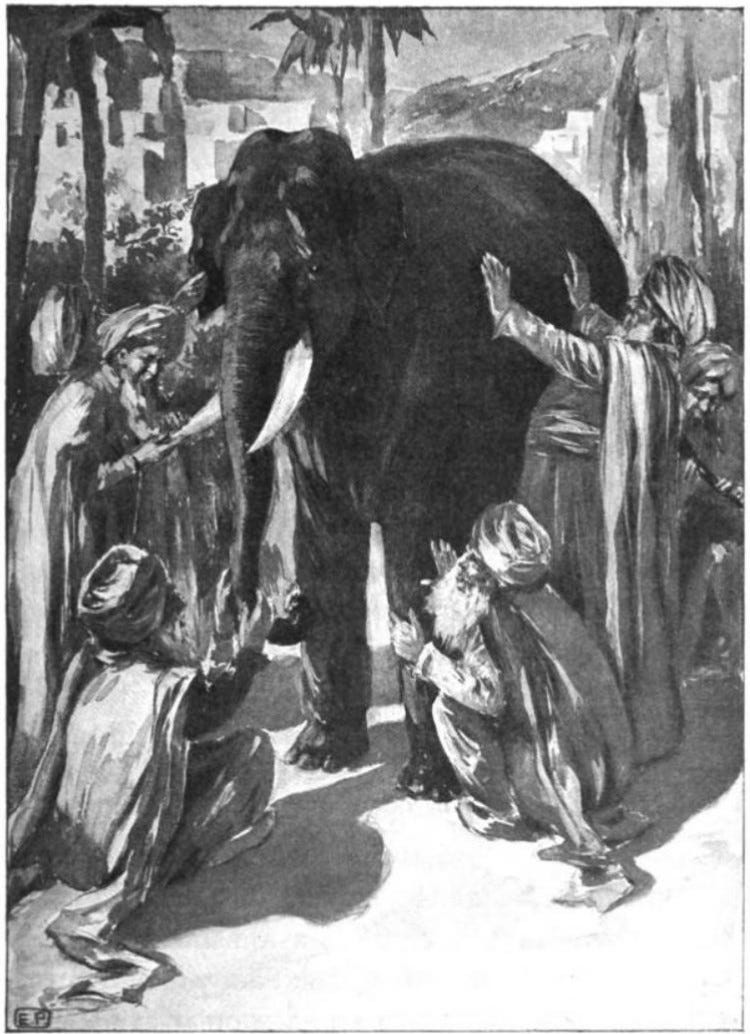

It’s not as though this sort of misunderstanding is unprecedented, although it’s presented in cautionary terms. There’s the parable of the blind men and the elephant, which dates back millennia in one form or another5:
A group of blind men heard that a strange animal, called an elephant, had been brought to the town, but none of them were aware of its shape and form. Out of curiosity, they said: "We must inspect and know it by touch, of which we are capable". So, they sought it out, and when they found it they groped about it. The first person, whose hand landed on the trunk, said, "This being is like a thick snake". For another one whose hand reached its ear, it seemed like a kind of fan. As for another person, whose hand was upon its leg, said, the elephant is a pillar like a tree-trunk. The blind man who placed his hand upon its side said the elephant, "is a wall". Another who felt its tail, described it as a rope. The last felt its tusk, stating the elephant is that which is hard, smooth and like a spear.
More to the point, there are cultural adages that circulate this idea more directly. There’s the admonition not to judge a book by its cover, for example. Or the warning that dates back well before Shakespeare that all that glitters is not gold (though he puts his mark on it in The Merchant of Venice alongside the observation that “Gilded tombs do worms enfold,” which I personally prefer!). At the risk of hammering too often on this particular nail, I want to note once more the fact that these are examples of the risks of synecdochal reasoning, the overgeneralization from part to whole, or the hasty reduction of whole to part. They manifest what Nguyen terms “the Gap” in his book, the distance between reality and what’s being measured.
Corporate tombs thus us enfold
The broader point of Nguyen’s book is that we too often find ourselves playing someone else’s game. It was perfectly within the rights of the executives at Coke to make their soda demonstrably worse. But there are all sorts of instances of ensippification that affect us, where we have little to no control over the metrics imposed upon us. They are exceptionally thin slices of our lives, shedding all of the inconvenient details of our individual contexts, in order to provide others with a scalable (if inaccurate) summary of our value. Another way of framing this transition is that we are called upon to convert the narratives of our lives into information. As Byung-Chul Han puts it in Infocracy, “Discourse is replaced by data.”
At the end of Nguyen’s book, he talks about how he experimented with ungrading in his university courses, an attempt to loosen his courses (and his students) from the economy of letter grades (and grade point averages). The theory behind ungrading is that it allows the classroom to move past the perennial question “What do I need to do to get an A?” towards “more important qualities, like curiosity, reflectiveness, originality, and openness.” As he discovers, though, “I’d hoped ungrading would give them the freedom to find their own love of the material. But they never actually explored the material long enough to fall in love with it, because they stopped coming after the first day” (318).
Before we even have a chance to choose, we’re entombed in these metrics, without the chance to reintroduce context to them. Grade point averages, standardized test results6, credit scores, etc., are all tiny, datafied sips of the variable and complicated lifeworlds that each of us inhabits. The information to which we’re reduced exists outside of time and space; it ignores (and ultimately erodes) what Han describes as the “temporal architecture” necessary for things like discourse, community, or democracy. Unlike the soda wars involving literal sips of beverage, the metrics that Nguyen discusses are ensippifying us, enabling the sorts of snap judgments that can have deeply material consequences for our lives.
I want to dig into this a bit more, and spend some time on specific examples, so I’ll likely spend my next couple of posts looking at the ways that this pattern extends across literacy and media. I also want to pick up the bit from my epigraph above about the “interface of social media” specifically. More soon…
I’ve gone back and forth about whether to humblebrag here. Insofar as I have an analogous skill, it’s the ability to coordinate seemingly disparate books/texts/ideas into unpredictable shapes. Usually this shows up in my ability to listen to someone talk about their work and then come up with potential connections or sources that they haven’t previously thought about. The fact that Nguyen’s book made me think of Gladwell’s, despite the 20-year gap between them, is one example of this, an intuitive resonance that probably wouldn’t occur to most readers. This doesn’t make me a genius or anything, but I do think I’m pretty good at picking up on the vibes of the ideas and texts that I run into.
And yes, I’ve been chewing over this idea in the more contemporary context of Ai, the degree to which it enables thought without actual thought, or LLMs enable writing without writing (even though “writing” means very different things on either side of that preposition). I may mention this later on, but part of our valorization of the snap judgment is the arguable view that it’s somehow necessarily more “efficient” than the alternative.
One of the things that made it easier for me to kick my own caffeine/cola habit was the fact that I worked on a “Pepsi campus.”
Interestingly enough, not only did the introduction of New Coke have the opposite effect—it failed to attract new customers and alienated their old ones—but “the seemingly inexorable rise of Pepsi—which had also been clearly signaled by market research—never materialized either” (158).
The Rashomon effect, named for the the 1950 Kurosawa film, is a more contemporary version of this parable. Last year’s Adult Swim show The Elephant alludes to it as well, an example of exquisite corpse technique.
One of the silver linings of the pandemic years was that it was much more difficult to administer tests like the SAT, ACT, and GRE. So we were allowed to waive the GRE as a requirement to apply to our graduate program. We’d never used it as a criterion, because it had no predictive value whatsoever, but our applicants still had to waste their money on it to be able to apply. We opted not to reinstate it moving forward.
Fabulous read.
I’m reading the disappearance of rituals right now. Highly recommend if you haven’t yet.
Being impressed with AI writng feels like a sip taste, no? First instance and even read through: seems amazing.
Sit with it and it gets way worse.