
Sycophantasy
Backrooms (2026) as allegory

About a month ago, I wrote about how much I was looking forward to Backrooms, although you might have missed my enthusiasm, considering how much time I spent situating it in a long (personal) context of weird spaces, to say nothing of its resonance with certain of my persistent dreamscapes. I used to go to the cinema to see just about anything that interested me, but I didn’t return to that habit post-shutdown, so it was a bigger deal (for me) than I probably let on that I was going to leave my house to see this film. Anyway, I waited until the opening week hullabaloo had died down a bit, figuring that a late weeknight screening would be best for me, and that proved to be the case. I came away from it with multiple layers of response, so I thought I’d share them here. Needless to say, there are spoilers in what follows.
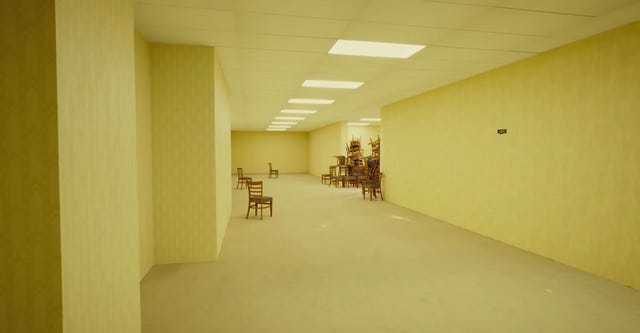
Backrooms, the movie
I’ve watched pieces of the original YouTube series for which the movie serves as translation, and I’m familiar with the lore of its origins, so I did go in knowing what to expect. That said, as a standalone product, the movie was pretty uneven. The places where it most closely resembled the found footage style of the YouTube shorts were the most successful, I thought, but the attempt to build them outward into a longform movie fell kind of flat. The cast is great, but they’re really not given much to do—the characterization was thin. The plot doesn’t fare much better—it feels constrained by the genre1 and there were some holes that broke the narrative for me as I was watching. I’m not sure that I’d recommend the movie to someone who wasn’t already invested in the viral phenomenon that preceded it.
Backrooms, the phenomenon
Those who are already committed in that way would almost certainly take issue with my impressions of the movie, and accuse me of not getting it. And there’s something to that defense. Even though I left the film pretty ambivalent about it, I think that it’s an unalloyed positive that the movie got made, that Kane Parsons was given the resources to try, even if I thought the result was middling. Not for a second did I regret supporting it at the theater.
I’m sympathetic to the argument that Katie Chiou (among others) makes that “Backrooms, both in its production and its deployment is a groundbreaking artifact of an emerging generation native to liminality2.” At the same time, I think this overstates things, considering the movie’s precursors, some of which I noted a month ago, but which would also include Blair Witch Project and Marc Augé’s book on Non-Places, both of which are more than 25 years old now. Despite this, I’m with Ted Gioia, who wrote earlier this year about how much of a dead end “mainstream” culture has become. “People will soon demand something more from the creative economy,” he argues. “something riskier, something more inspiring, something more disruptive.”
I do understand that A24 (the studio) was more interested in translating millions of YouTube views into ticket sales than taking some principled stance on culture. That’s okay. If that’s what it takes to place some of those studio resources into the hands of creators with new visions of what movies can look like, as opposed to the gruel generated by IP factories and/or Ai, I’m all for it. A movie doesn’t have to be for me in order for me to appreciate it.
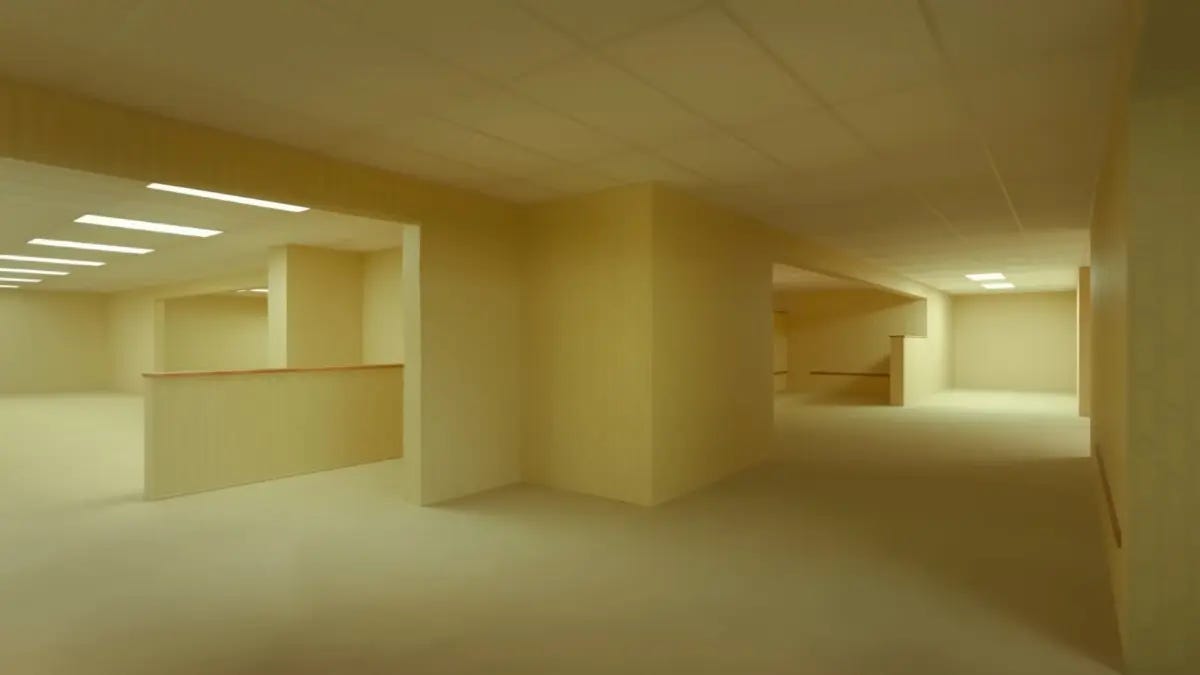
Backrooms, the narrative
I suspect that the process of making Backrooms presented very real challenges for a fledgling director. Parsons was chosen, on one hand, to represent a very specific vision (not to mention the audience that emerged around it). But he also had to translate his YouTube, found footage vibe into a much different medium. Chiou notes that the movie could have been “better,” and/or executed by a more experienced filmmaker, but that “they still would have had to translate it into cinema from the outside.” And that would perhaps have sacrificed much of that original vision.
Rather than settling on one side or the other of this conversation, I found myself working out a third take, as my experience of the movie began to settle in. The more I thought about it, the less I cared about either the movie’s technical flaws or cultural exigence. Instead, I found myself thinking about it more allegorically.
[To be clear: I’m not saying that this was Parsons’ intent, or that this is somehow the real meaning of Backrooms. What emerged for me this week was an interpretation that I found compelling, as opposed to something that I found right or wrong necessarily. It’s more of a personal take on the movie, one that intentionally sets aside the extended universe of the backrooms3. And here’s where the spoilers begin.]
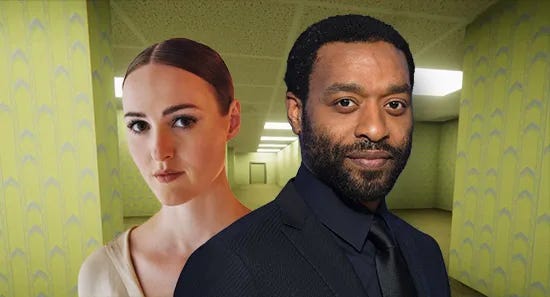
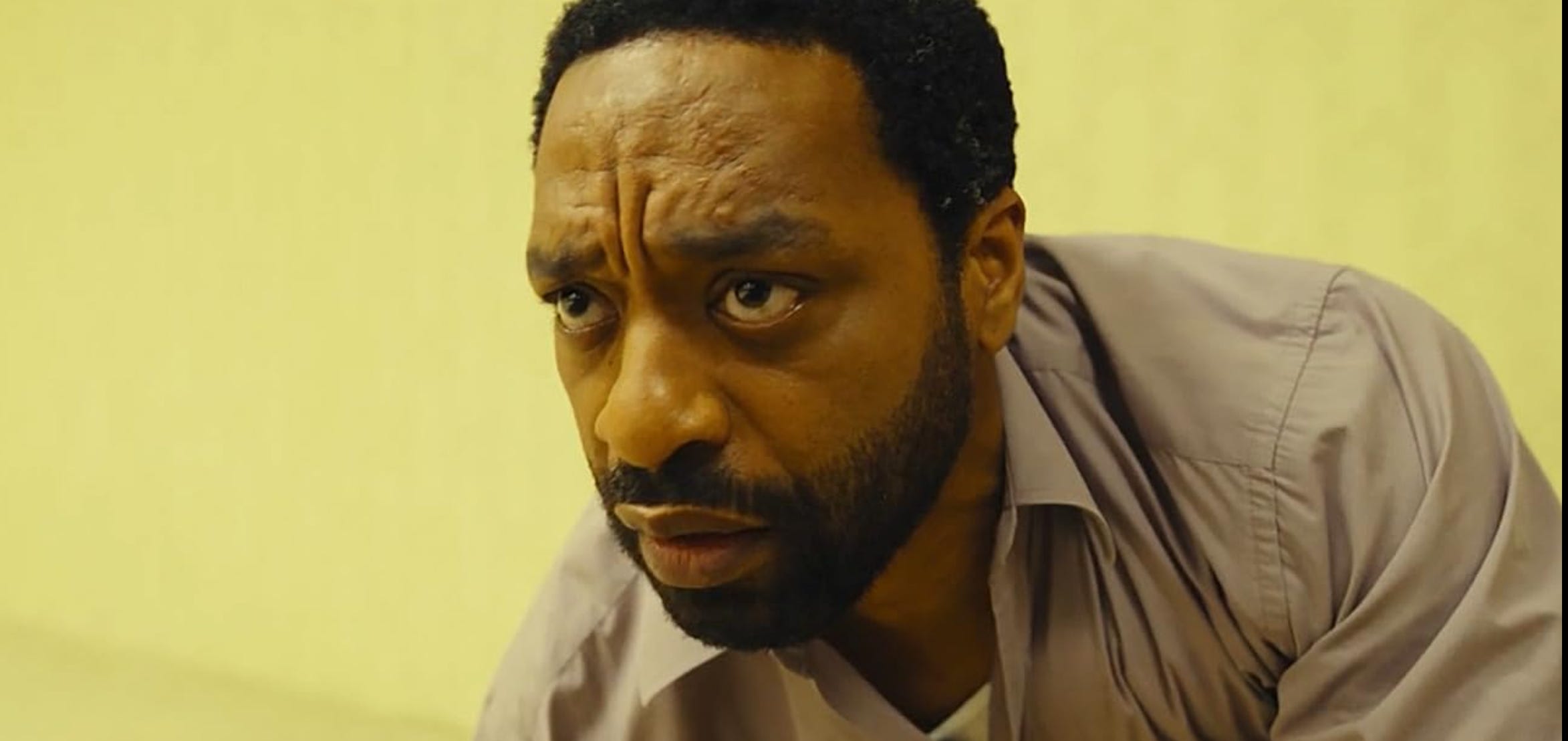
The movie’s two main POV characters4 are Clark (Chiwetel Ejiofor) and Mary (Renate Reinsve). The movie begins from the perspective of Clark, who studied to be an architect but now finds himself managing a bleak, strip-mall furniture store (Cap'n Clark's Ottoman Empire!!) and making humiliatingly “wacky” tv commercials on its behalf, so that he can support his (ex)wife’s (seemingly casual) attempt at law school. Clark is depressed, drinks a lot, and holds onto a fair bit of rage over what he perceives as an unfairness at the core of his marriage.
In an attempt to manage/resolve that anger, Clark is a patient of Mary, a therapist who specializes in helping patients break out of the behavioral patterns that constrain or trap them. At one point, we peek in on a nightmare that Mary has of her childhood, where she was raised by a severely agoraphobic (and schizophrenic?) mother who wouldn’t let her leave the house, nor even open a window. Mary’s shtick, which is a little on-the-nose then, is that she encourages her patients to open doors or windows onto other ways of proceeding with their lives.
Their most detailed interaction comes at the beginning of the movie, where they re-enact a conversation between Clark and his (then) wife Barbara, where he had gone out drinking after work, come home late, and woken her by dropping/breaking a glass in the kitchen. Barbara comes down to confront him, and this escalates into a full-throated vent of his resentment and frustration. Clark feels fully justified in his anger, and it’s pretty clear that he’s ambivalent about therapy. (This reenactment is relevant because it will happen one more time, much later in the movie.)
Clark leaves, and it’s at this point in the film that he discovers the backrooms. Fascinated by the space (he’s an architect!), he begins to explore it, and he comes back to Mary one more time, with a hand-drawn map of the space, to try and explain to her what he’s found. Clark sounds pretty crazy, and Mary uses her “institutional distance” voice to try and get him to slow down. Naturally, this infuriates him and he stomps out.
The movie continues from Clark’s perspective, for some time, and I won’t spoil what happens. The (conceptual) second half of the movie shifts to Mary’s perspective. She’s received a cryptic voice mail message from Clark telling her that “I opened the window. I won't be coming back.” Justifiably alarmed, Mary sets out to try and find Clark, ends up at Cap’n Clark’s, where she eventually discovers and passes through the portal into the backrooms herself.
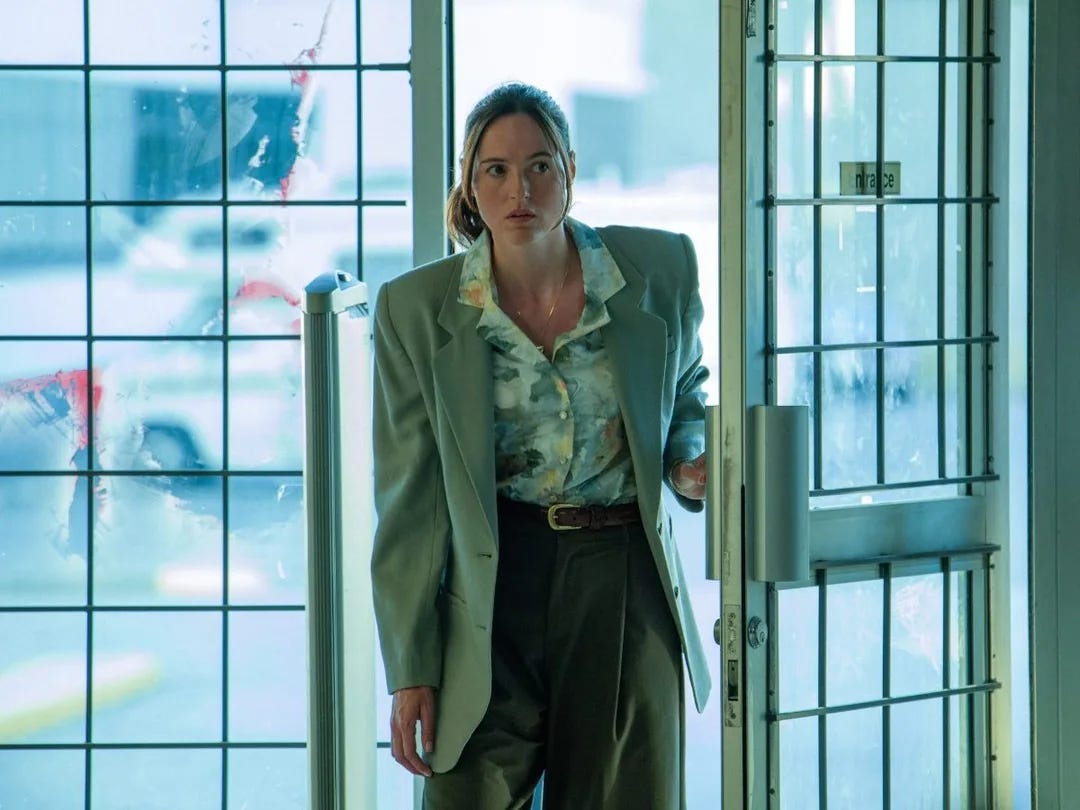
She’s able to locate Clark, but he chokes her out, and she wakes up tied to a chair seated at a kitchen table across from him, with three other “people” in the room with them5. Mary is forced at knifepoint to repeat that conversational reenactment from Clark’s therapy session, but instead of trying to persuade him to take responsibility for his anger and change, she validates him. She tells him that he should stay in the backrooms if he wants, that some people are just wired differently. This is enough to break through to Clark, and he releases her. There’s a bunch more to the story, including Mary’s ambiguous exit from the backrooms. The movie ends with an encounter between Mary and Phil, but I’ll hold off on saying much more.
Backrooms, the allegory
Simulation is no longer that of a territory, a referential being, or a substance. It is the generation by models of a real without origin: a hyperreal. The territory no longer precedes the map, nor does it survive it. It is nevertheless the map that precedes the territory—precession of simulacra—that engenders the territory, and if one must return to [Borges’] fable, today it is the territory whose shreds slowly rot across the extent of the map (1).
Jean Baudrillard, Simulacra and Simulation
I’ve focused much less on the backrooms themselves, and instead on the context for their appearance, because it was that narrative pretext that ended up sticking with me. From a plot perspective, it establishes a connection between Clark and Mary, where Mary stands in for the outside world and a potential exit from the destructive patterns that have captured Clark. The characterizations for both Clark and Mary—his background in architecture and her brand focus on spatial therapeutic metaphors in light of her mother’s agoraphobia—are a little on-the-nose, so they’re easy to dismiss in favor of the eerie, uncanny nature of the backrooms themselves. It’s the title of the movie, after all, so we go into the experience with the presumption that the backrooms themselves should occupy the foreground, with the therapy serving as an introductory plot device.
But I want to flip that assumption, because I think that much of Backrooms is an allegory for Ai psychosis.
The actual shift that Clark undergoes happens almost entirely off-screen, during the stretch where the movie shifts its point of view to Mary. It’s not until Mary finds Clark, and then wakes up in the kitchen/room that we even realize that something’s wrong. But there are hints. Clark already feels pretty isolated from other people at the outset of the movie, having just ended his marriage. He seems less interested in change than validation in his early interaction with Mary. And while his initial forays into the backrooms code as creepy and potentially dangerous, he becomes obsessive, hoarding objects, trying to map out the space, and eventually enlisting the help of his assistant and her camera-toting boyfriend. The notion that he has “opened the window,” in a space markedly devoid of exterior windows, suggests the sort of delusion that has become more frequent these days in light of so-called Ai therapists. Clark’s assault of Mary comes as a shock, but his behavior when she wakes up is pretty unhinged.
Architecturally, the backrooms look like what might happen if you trained an LLM on Christopher Alexander’s A Pattern Language without also giving it access to The Timeless Way of Building, and then asked it to create a space. To be less academic about it, it’s an assemblage of spatial features without any attention paid to the way that humans might use or react to it. If a door is simply a thing that connects one room to another, there’s no reason why it can’t just as easily appear in a floor or a ceiling. In fact, calling it architecture is almost a misnomer, in the same way that I think it’s misleading to describe the output of LLMs as “writing.”
Writing about how Ai is reconfiguring the ratios between our conscious and unconscious, L.M. Sacasas explains of the chatbot interface that
It offers a false clarity and lulls us into self-satisfaction, guarding us from self-doubt and from lingering too long in an awareness of our ignorance or in a place of troubling uncertainty. It veils the tangled forest of human experience and lights an artificially clear path for us toward the promise of knowledge and wisdom. In this way, though, it sinks us gently but decisively back into the unconscious. Perhaps this is the root of AI psychosis.
We’re not privy to the “clear path” that Clark identifies. Our only evidence of it is the voicemail that Mary receives. But the backrooms evolve, shaping themselves around the presence of the people who visit them, recreating features of their memories, up to and including other people (albeit without the pesky demands or expectations of sociality that other people present to us). This space makes the unconscious manifest in a way that validates its inhabitants. In a very real sense, then, the backrooms are sycophantic.
Knowing this, there’s an intrinsic ambiguity to the movie’s ending (specifically Mary’s interaction with Phil) which raises a broader question about whether it’s ever possible to leave the backrooms. Do the backrooms actually represent an alternative, secret space or simply distill an uncanny hyperreal that’s already preceded us? Jason Lee suggests a productive analogy with doomscrolling, explaining that already, “We move through informational environments that are effectively infinite, yet curiously repetitive; that promise knowledge yet often produce anxiety and paralysis and the same rage.” He suggests that the terror of Backrooms is “not external invasion but internal resonance.” Chiou argues that the movie represents “a coherent aesthetic category for the embodied structure of contemporary, online life,” one that younger generations have spent their entire lives experiencing.
I think Chiou is dead-on accurate in her emphasis on embodied structure. Those of us who are older still tend to think of technology as tools that we can use (or choose not to), but we’re raising generations who experience them primarily as environments, and we tend to discount this generational shift, despite the rise of the (spatial) metaphor of the “platform” to describe it. Sacasas puts it bluntly at the beginning of his latest post6: “Your AI is not a tool. It is an environment, and you are in it.” Later on, he explains that what we persist in thinking about as “tools” are actually “an environment which envelops the user and works on us from the inside out while we naively think that we remain unchanged by our use so long as we are using it carefully and intentionally.”
Sacasas expresses the wish that this point “be put as forcibly or vividly as possible so that this vital truth lodges not only in our mind but in our heart and gut,” and that really resonated for me, because it was my experience upon watching Backrooms. More viscerally than any Substack post I’ve read, the movie dramatizes (and translates spatially) the way that many seem to interact with their chatbot companions and therapists. And it exposes the dread that I feel at that prospect.
Backrooms, my conclusion
Like I said, I’m glad I saw this movie and that I supported its theatrical release. For me, it taps into something that captures the same primordial horror indicated by Jean Baudrillard’s description7 of “the territory whose shreds slowly rot across the extent of the map.” We craft our conscious selves atop the primordial soup of our unconscious; similarly, we build society (and shared discourse) through collaboration with one another, painful and frictive as that can sometimes be. Backrooms is valuable precisely insofar as it vividly demonstrates the danger of losing that. The prospect of retreating individually into worlds that shape themselves around us, whether it’s by passing through a wall or convincing oneself that a sufficiently flattering chatbot is indistinguishable from consciousness, should provoke horror in us all. There’s more to the movie than this particular interpretation, to be sure, but that’s what I ended up taking from it for myself.
Dan Erickson, who created Severance, has publicly cited Backrooms as one of his inspirations, and I found myself wondering if a serial treatment wouldn’t have been better here as well.
Having watched and read a few commentaries now about Backrooms, I assure you that “liminal” is an early frontrunner for word of the year. I cannot tell you how many times it’s been deployed in discussions of the movie.
There have been long debates, for example, about whether Lord of the Rings was an allegory (for WWII-era Europe, the emergence of atomic power, e.g.). The answer is yes and no. It clearly wasn’t intended as such, but that doesn’t mean that it can’t be read that way, even if it goes against the grain of authorial intent. My point here is that I think there’s an interesting allegorical reading of Backrooms, not that I consider it to be what the movie is “about” or what Parsons intended.
A third character (Phil) briefly takes point of view at a couple of moments during the film, but he doesn’t appear or interact in the narrative until the very end. The only other name characters from the cast are Clark’s assistant Kat and her boyfriend Bobby, who owns the camera with which they film those commercials.
These people are literally grotesque, called “Still Life” in the Backrooms lore. According to that lore, they are lifeforms native to the space that have been created by the backrooms as approximations either of people who have visited or based upon their memories. There’s a strong “Ai slop” vibe to them, which you can see by following that link.
His latest came out right as I was putting the final touches on the formerly final draft of my own episode. But I couldn’t not include it here.
I never quite found the place to include this, but you might recognize the book of Baudrillard’s that I cite above as the one that Neo (Keanu Reeves) uses to hide his money in The Matrix. I think there’s an interesting case to be made that Backrooms, with its roots in video game aesthetics, functions almost as a proto-Matrix, given how it draws on the memories (and life force?) of those who inhabit it.