
Summer Homework, continued
Part 2: The End of the Tour (2015)

Last episode, I set myself an assignment based upon Ted Gioia’s list of the nine best films on the creative life from the 21st century: rewatch one of the 5 movies on that list that I’d seen before, and watch one of the 4 I hadn’t. So last episode was about Stranger than Fiction, a modest metafictional film from 2006 starring Will Ferrell, Emma Thompson, and Dustin Hoffman.
In order to complete the second part of my self-imposed assignment, I watched The End of the Tour, a 2015 “biopic” based upon David Lipsky’s 2010 memoir Although of Course You End Up Becoming Yourself: A Road Trip with David Foster Wallace. Then working for Rolling Stone, Lipsky visited Wallace in Bloomington as the latter was ending up his initial book tour for Infinite Jest. The interview was never published, but the raw material (5 days worth of tape-recorded conversations) formed the core of Lipsky’s book. Wallace is portrayed by Jason Segel, while Jesse Eisenberg plays Lipsky, and other than a couple of cameo appearances by other actors, the vast majority of the movie is taken up by conversations between the two mains.
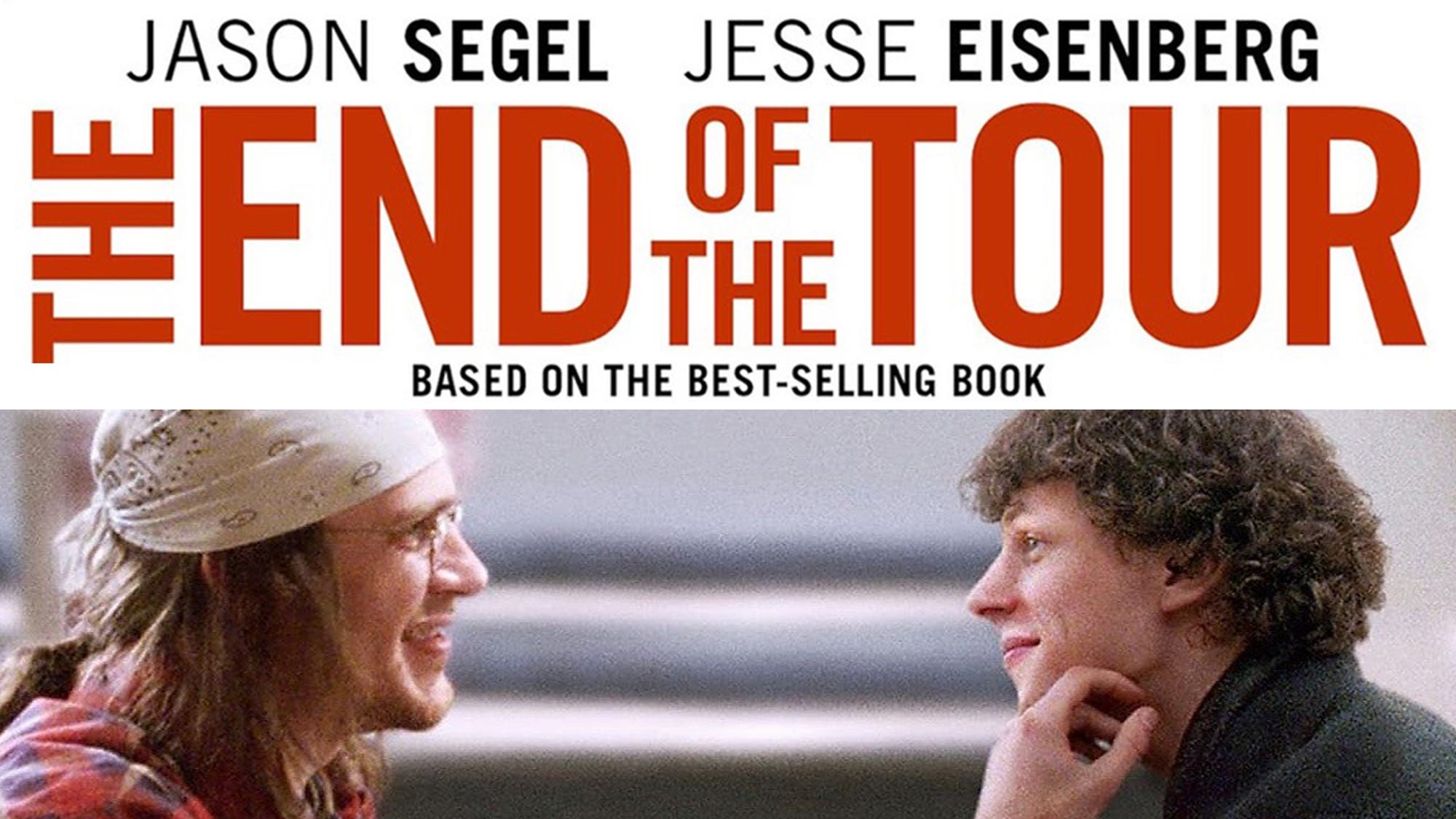
This is a challenging movie to write about (for me, at least). One of the reasons it feels overwhelming is that it crosses all sorts of different contexts and scales. It’s a 2015 movie, based on a 2010 book, based on a series of interviews conducted over a few days in the late 90s (Infinite Jest was published in 1996, so without checking, I assume that the interviews took place in late ‘96 or early ‘97.). But then there’s the Wallace of it all.
I’m of an age where I (vaguely) remember the hullabaloo surrounding Wallace and Infinite Jest. I was only a few years younger than Wallace, I cared about some of the same issues that he did (and satirized), and at the time, I still harbored dreams of one day writing a novel. (It’s probably also important to mention that this was in the very earliest days of the Internet as we would come to know it.) Insofar that I remember being on the margins of the literary world, it’s hard to overstate how much of that world warped itself around Jest at the time1. Before social media all but emptied out the idea of virality, Jest was certainly a viral phenomenon.
And honestly, that’s kind of the place where the movie itself opens, with Lipsky reading from his recently published (and relatively unknown) novel to a small, half-interested audience2. The novel that’s captured everyone else’s (including his partner’s) attention is Infinite Jest. Lipsky works a day job at Rolling Stone, and he talks his editor into arranging a feature on Wallace. One of the things that the film does really well, I think, is quickly introducing the layers that we end up negotiating as audience—there’s an ambiguity to Lipsky’s motives. Wallace has accomplished what Lipsky has not in terms of success and notoriety, so there’s clear envy. There’s the parasocial extent to which we feel like we “know” those who are successful3. Both of these inform Lipsky’s desire for “shine by association,” and the movie’s framing scenes (Lipsky’s book readings pre- and post- Wallace) encourage that interpretation. Lipsky’s editor presses him to exploit this opportunity to break a story about the rumors of Wallace’s drug use. And then there’s the parasitic/vampiric relation of the media in general, multiplied by the interview that turns into articles and later a book, and eventually the movie that we ourselves are watching.
I wrote about one of Wallace’s essays last summer, and I’ve talked about the way that “This is Water” connected with my own understanding of digital writing, so it’s fair to say that I came to the movie with a sensitivity both to its layers of mediation and to the question that many of its reviews end up addressing (“What would DFW have thought about it?”). But I don’t know that this helped.
The movie itself is largely unremarkable, at least compared to the cinematic spectacles that dominate the contemporary box office. A guy in New York talks his boss into paying for him to spend a few days with a Famous Author living in Indiana, and they talk a bunch. The text and texture of the movie is ordinary. The movie only becomes interesting as its context emerges, and even that (within the movie itself) is limited. As I thought about how to frame my own reaction to it, I found myself getting more engaged, reading reviews and proclamations around the movie’s release.
And what I learned as I did so was that I found both sides of the “argument” pretty convincing. On the one hand, I think that Wallace would have been uncomfortable seeing himself, as Megan Garber puts it, transformed into media. Towards the end of the movie, as Lipsky is leaving, Wallace tells him that the worst part of fame “is that I get to like it,” that he would become accustomed to its hyperbole, its spectacle, its artificiality. It’s difficult to imagine that he would have been pleased to have his words framed by someone else for an audience’s consumption, without any say over what appears on screen. And that’s to say nothing of all of the ways his work has been taken up (and flattened) across social media…
On the other hand, though, there remains a sizable (no less vampiric) industry devoted to protecting (gatekeeping?) the “real” when it comes to celebrities, and I’m not entirely convinced that that approach to Wallace’s life and thoughts is intrinsically healthier. There’s a scene in the movie where Lipsky calls attention to an Alanis Morissette poster in Wallace’s house, really awkwardly, and he talks about how “absolutely riveting” she is, precisely because she’s not polished and perfect. It’s an interesting parallel for Wallace himself: not only does his meteoric rise create the necessary conditions for the interview itself, but it attracts the kind of attention that would be paid to his depression, his self-absorption, bouts of domestic violence, etc. So maybe it’s not the worst thing in the world for a writer like Wallace if portrayals like these keep him from fading into abstraction the way that celebrities often do?
And on the third hand, I found myself positioned by the movie in both these ways. I could feel in myself some of that mediated desire to know what made Wallace tick, at the same time that I identified with his wariness of the entire amplifcation industry (I’ve written about my own lower-v viral experience). I thought that the casting of Segel and Eisenberg was really smart across a range of registers. One review that I read of the movie proposed that it could be understood as a “love story,” but one where either side of the relationship didn’t really match up with the other. That is, both characters seem to want something from the other that just isn’t possible, at least not to the degree that they hope. I think that I ended up seeing it less as movie and more as dialogue. And that dialogue functions more allegorically4 than anything else, a staged encounter between art and commerce, perhaps.
The End of the Tour made me think a lot more than the average movie does, but that’s mainly because of the context surrounding it. The more that I read around it—the reviews, the opposition to it, the place it occupies in both Wallace’s and Lipsky’s careers—the more I appreciated the nuanced tension between the two characters at its core. I’m not sure it’s a film that I’d recommend watching cold (ie, without any background knowledge), but I wasn’t unhappy that I’d watched it myself. More soon.
My copy still occupies active, primary shelf space, even if I haven’t touched it in years and years. And it’s not unusual to see it on the shelves of any number of book tubers and tokkers.
The closing scene has him reading a passage from his book about Wallace, to a much larger audience, and that’s not accidental.
It was interesting to go back and see some of the discourse surrounding the movie. Wallace’s wife and some of his friends adamantly opposed the movie’s release, and felt that it violated the author’s own principles. (Wallace himself had a fraught relationship with his own celebrity.)
I’d have to think about this a bit more before committing wholeheartedly to it, but the one analogy that occurred to me right away was Steve Martin’s Picasso at the Lapin Agile.
I'd forgotten I'd seen both of these movies. Thanks for putting into words all the different things I was feeling/thinking while watching "end....". I enjoyed the movie, wish there were more like it, and felt it shouldn't have been made. A trifecta of sorts!