
Scammed!
Fool me once, shame on internet

One of my favorite memes has been around for a few years now. It’s called the Unfinished Horse Drawing on Know Your Meme:

KYM explains that “Unfinished Horse Drawing is an exploitable image macro of an illustration of a horse split into two halves, one detailed and the other crude. The image has been used to describe the feeling of being rushed through a task and to express the feeling that something's quality has diminished over time.”
For me, this meme captures the vibe of a much older internet phenomenon, clickbait (in my head, I think of this meme as “One Weird Horse”). Metaphorically speaking, clickbait teases us with a glimpse of the backside of the horse, only to reveal the entirety of the drawing once we’ve clicked the link, had our “traffic” registered, and our eyeballs scalded with junk advertising. Clickbait was the natural outgrowth of internet metrics that rewarded “clicks” rather than any sort of actual value. (It’s also the epitome of the kind of social-media-fueled irony that I’m critical of on this site and in my writing.)
By now, most of us know to discount all of the once-popular phrases that signaled clickbait: “one weird trick,” “you won’t believe what happens,” “X things you need to know about Y,” or basically any list of things, one of which “will surprise you!” For a long time, this style of manipulation was so prevalent on sites like Facebook that they eventually took steps to combat it.
Between that and a heightened savvy when it comes to internet fraudulence, we like to think that we’re largely immune to the sort of heavy-handed, manipulative garbage that circulates to this day online. Personally, I like to think that I’m pretty good at sensing when something’s off, even if it comes from a source that I trust. As Department Chair, I’ve seen multiple attempts from folks spoofing my email address to try to phish my colleagues. If I receive an email or a text from someone I know that feels off, I know to switch platforms to double-check it, and 95% of the time, I’ve been right to do so.
But this is not a post about how smart I think I am.
From about mid-November on, I start shopping for holiday gifts for my friends and family, and that means that I’m especially alert for potential deals. So one day, on Facebook, I came across an ad like this:
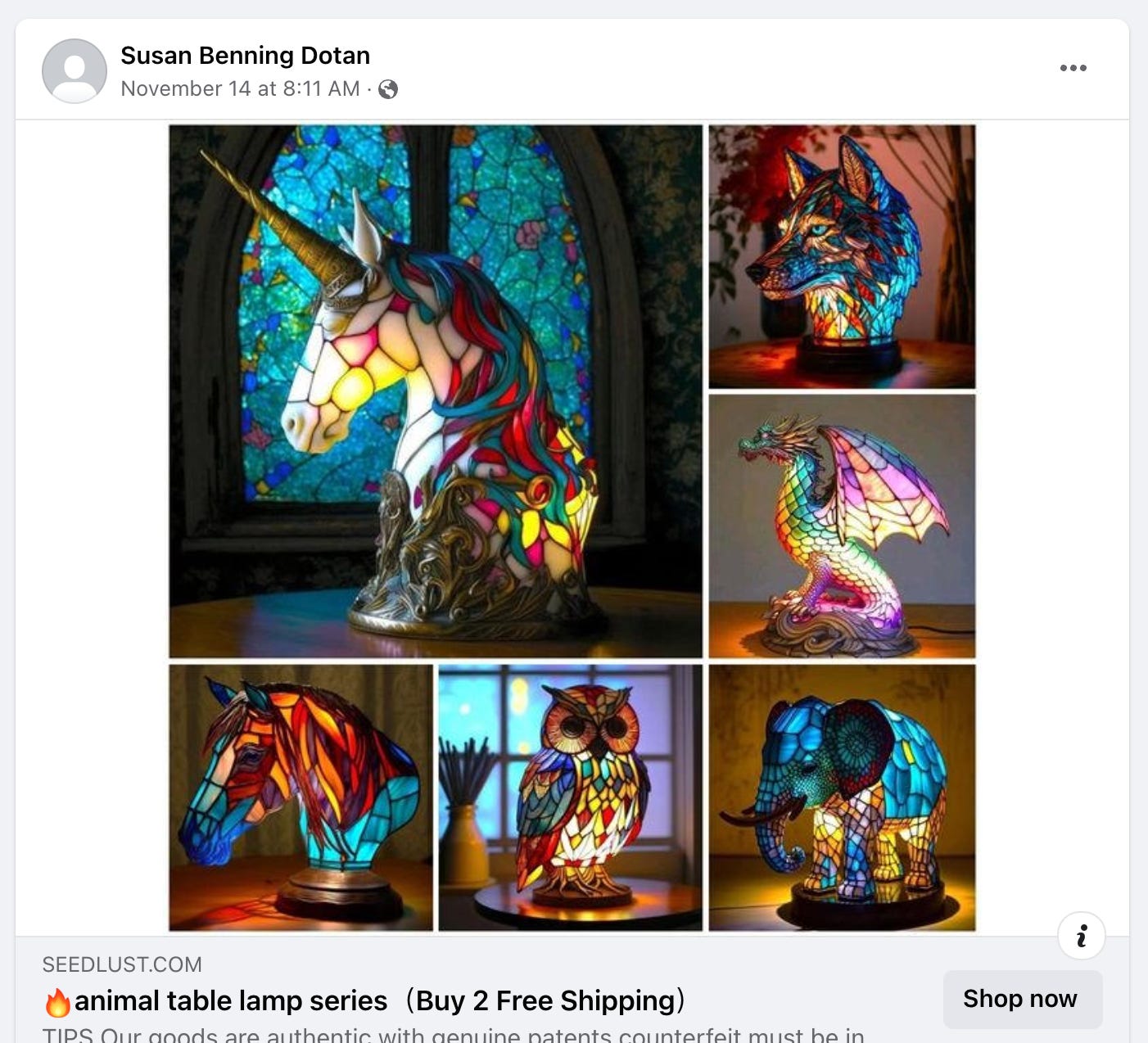
I thought they looked kinda cool, so I clicked through to a virtual storefront, browsed the choices, and decided to order the dragon pictured above. I thought that it might be a nice little accent piece for my office. Plus the “store” whose ad I’d clicked on was allegedly “going our of business” and had cut their prices by just over 50%. For a hot minute, I thought I was getting a decent deal on something.
(As a side note, I’d mention that geometric, stained glass style art is a personal favorite of mine. For nearly 10 years, I’ve had phone cases featuring the work of Manoou, a French artist whose work really resonates for me. My current iPhone case is Monsieur Chat.)
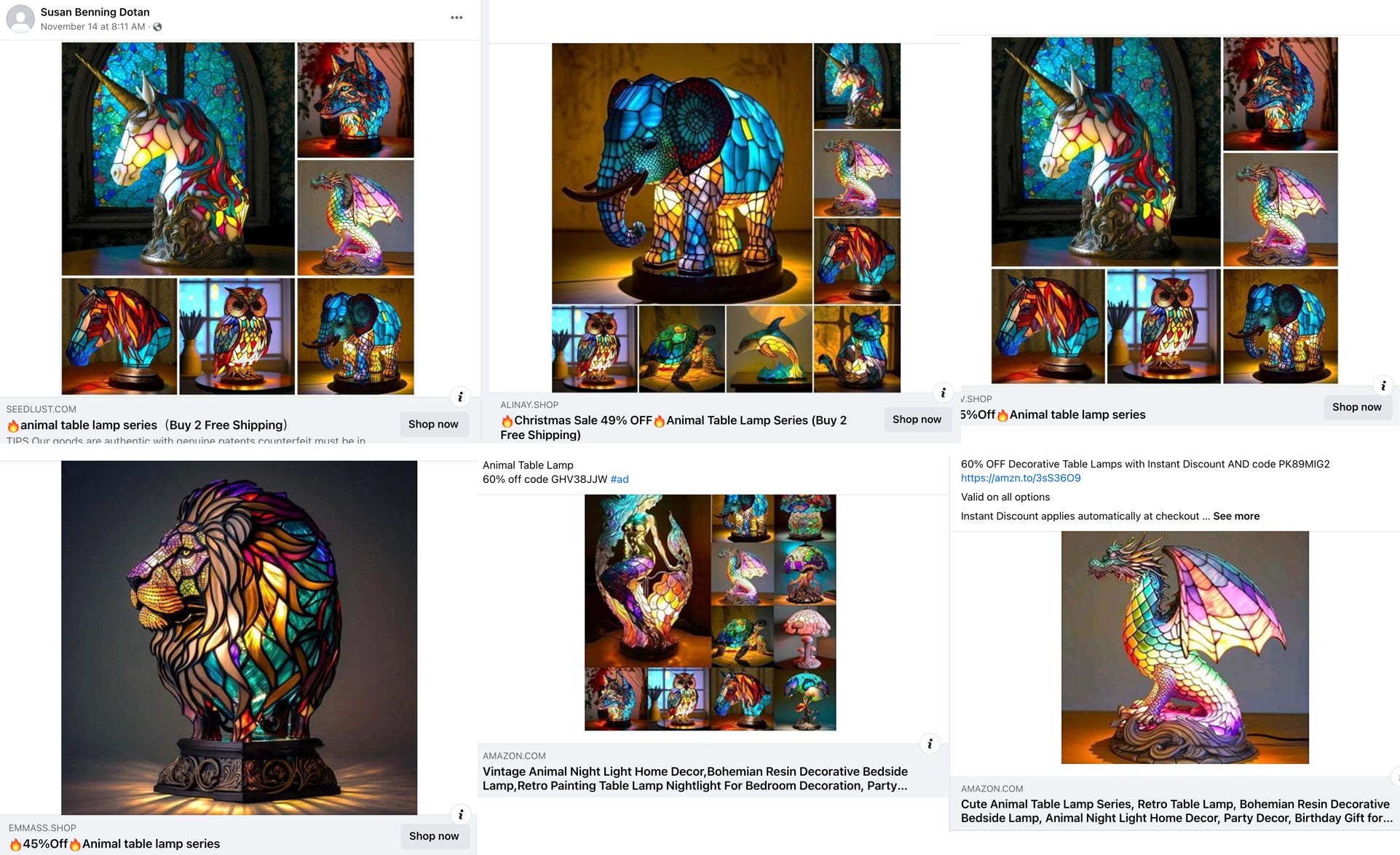
The first indication I had that something might not be on the up-and-up came from Facebook itself. Once I’d clicked on that initial ad, FB fed me a steady diet of other “stores” featuring the exact same products. When I checked the email receipts (and my Paypal log), I discovered two different personal gmail accounts listed in separate places for contact, which didn’t inspire much confidence. I was ready to pull the plug on my order, but I figured I’d go through it, just to see what happened.
I’ve slowly learned over the years of online shopping how badly language can be abused. One of the things that I added to my office last year was a whiteboard that would also accommodate magnets. In other words, it has a metal back with a layer of (plexi?)glass to write on. Any magnets I use need to be strong enough to adhere (and hold things) through that glass layer. Regular magnets don’t work for this, so I went online to try and find “strong” magnets, only to discover that nearly every magnet I could find (and a few that I bought) described themselves as strong. (Spoiler alert: they were, in fact, not.)
Perhaps you’ll see where I’m going here. While there’s a certain degree of ethics involved in accurately describing your products (an ethics more than often ignored by purveyors of magnets), you can name a product anything you like, and there’s no real recourse for the customers who are misled. So you might have certain expectations from products in an “Animal Table Lamp Series,” particularly those called “Handcrafted Vintage Stained Glass Table Lamps.” But honestly, and especially if you’re opening up your own fly-by-night virtual storefront, there’s nothing to stand in the way of selling crumpled up balls of notebook paper and naming them thusly.
The discerning customer is unlikely to send you their hard-earned money based simply on the name of a product, though, so the enterprising vendor adds other features to their storefront. For example, they might include dimensions like so:
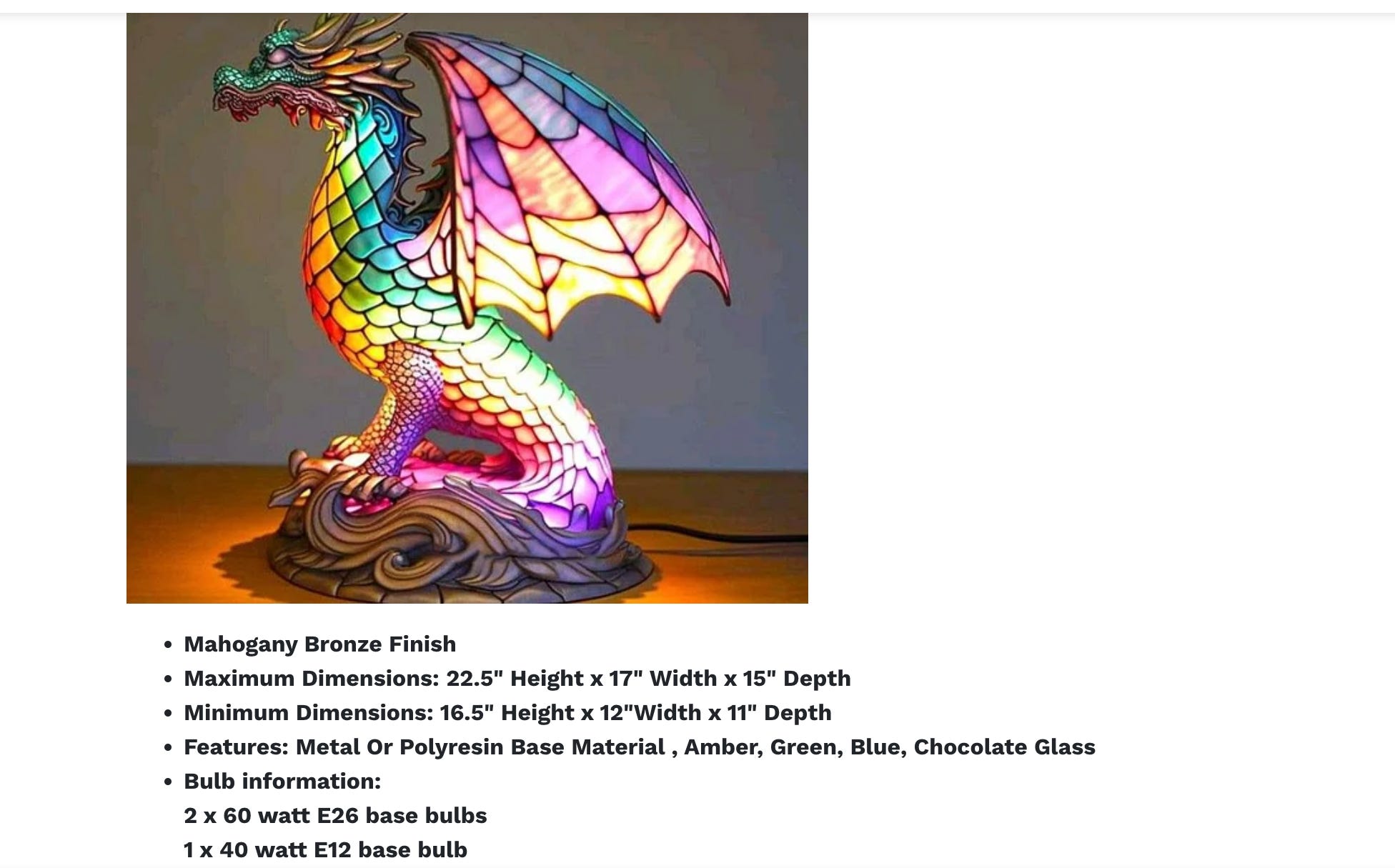
The more gullible among us, like I was, might interpret these bullet points as referential, as a description of the product next to which they appear. However, the site doesn’t say this explicitly. Spoiler: when it says “metal or polyresin,” the fact that there is no metal at all isn’t technically inaccurate. Also, “Chocolate Glass” appears to be their own name for a color, because there is no glass in the product. Finally, I really appreciate the touch of including a fake electrical cord in the picture, leading me to believe that this would be an actual lamp that plugged into an outlet. (It is not.)
By this point, you may be wondering what exactly I did receive for my troubles:
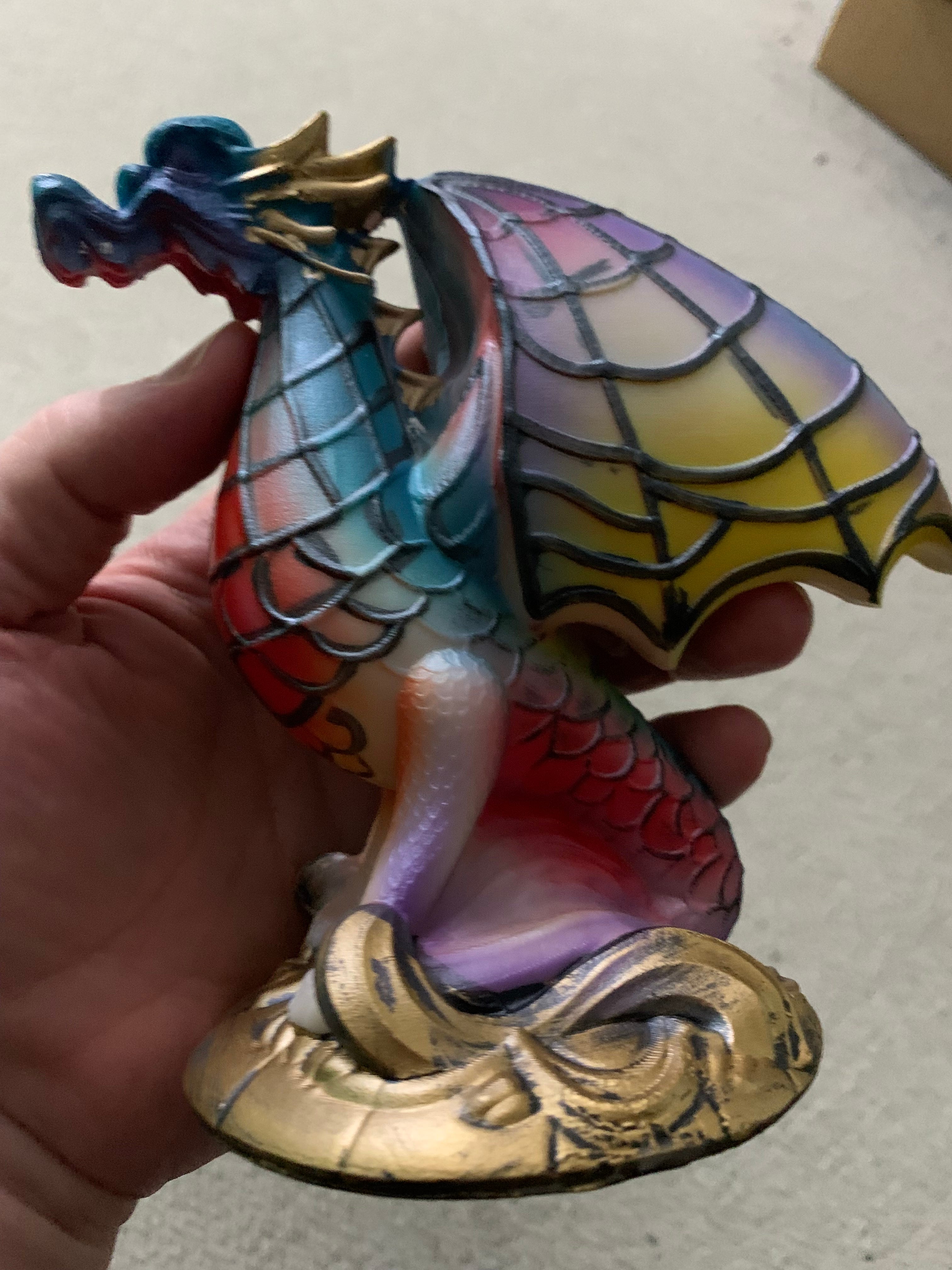
My hand is neither 16 inches tall nor 12 inches wide, which is how I know that those dimensions listed above may describe something other than the product I paid for. Nor is there any metal, glass, or “mahogany bronze finish” in my product. Instead, it is a cheap hunk of molded, yellow plastic (polyresin!), underneath which a hole has been drilled and an inexpensive toy light glued in. Here’s what it looks like alight.
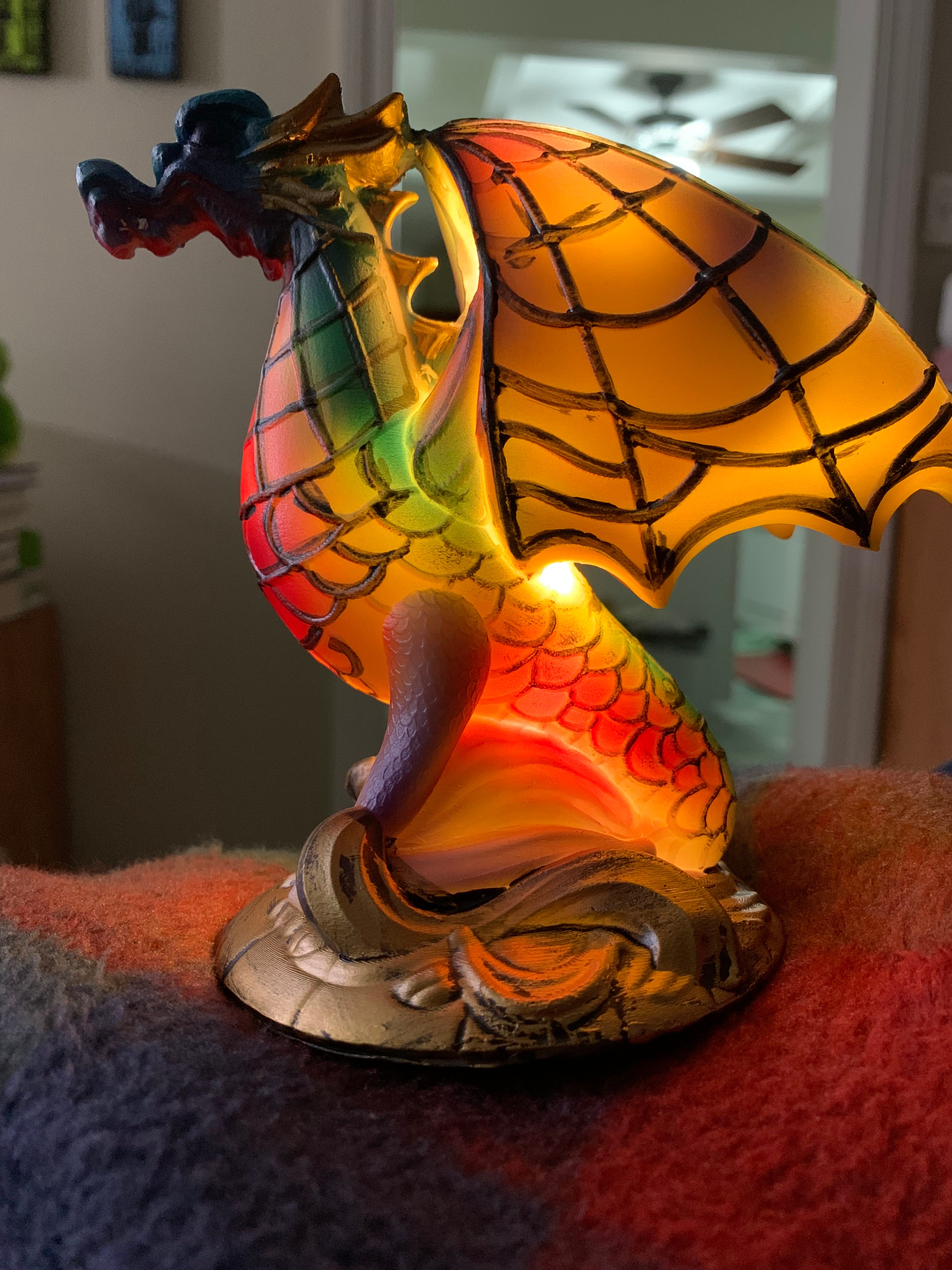
Just a bit different from the original advertisement lol.
The funny thing is that I’m not even really mad about it. I’m just shaking my head over my gullibility, and I’ll keep the dragon on my shelf as a reminder not to allow myself to click on a Facebook ad again. Ever.
And if nothing else, I now have my own personalized variation on the Unfinished Horse Drawing, to memorialize the lesson.
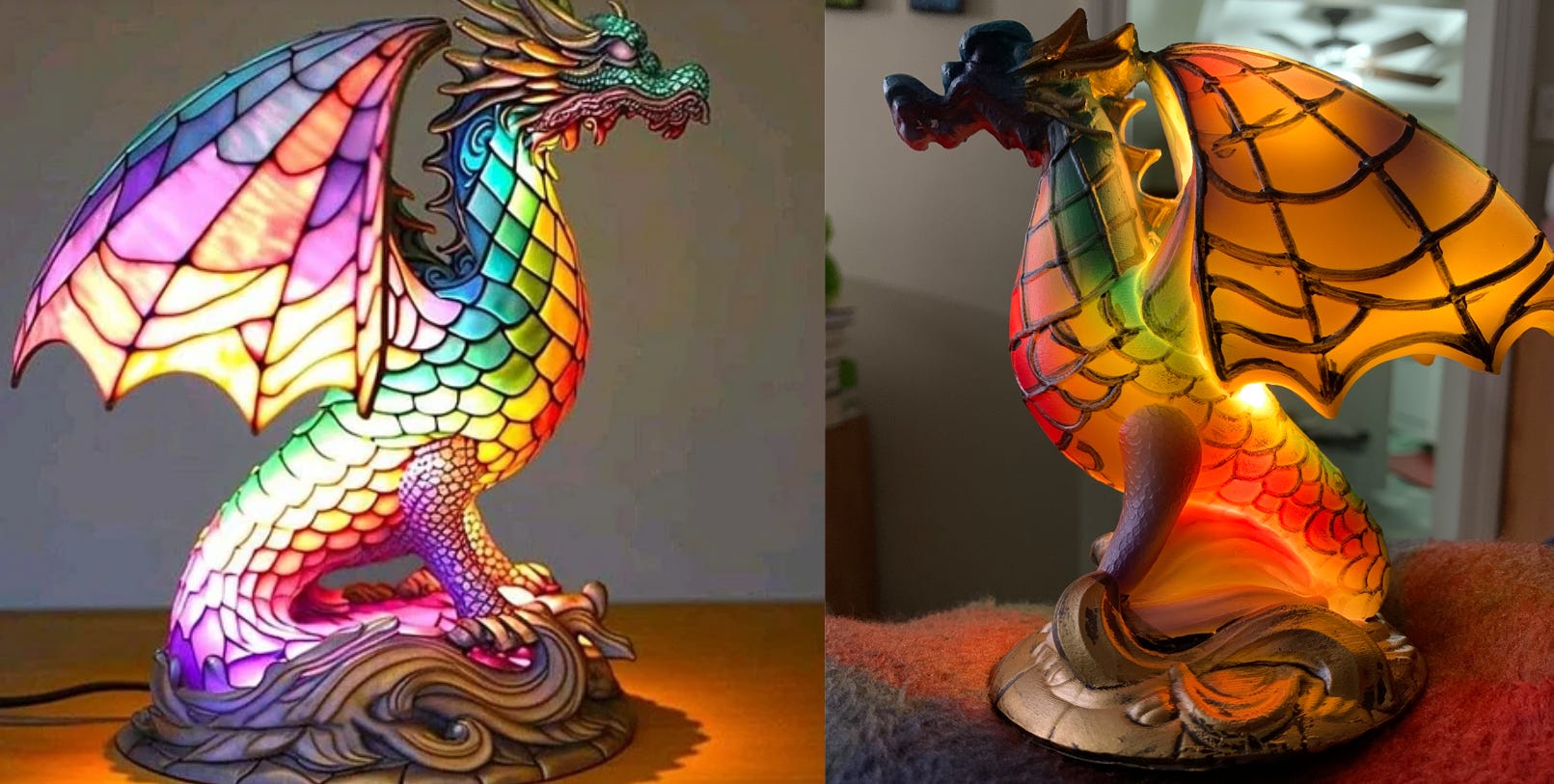
I mentioned above that the “store” I used claimed to be “slashing its prices” because it was “going out of business.” Much like the fake product information, these are all ideas that we’re comfortable with when it comes to physical stores, and so we don’t question them in an online context. It costs these stores nothing to claim a crossed out higher price. (I could offer a special, 75%-off subscription rate to this site, simply by putting $20 next to the $5, for instance.) And technically, every company that doesn’t plan on lasting forever is “going out of business”—it’s a meaningless phrase for an online storefront. We are easily manipulated by off-brand abuses of phrases and terms like these, or at least I was this time.
(And yes, the “store” that sold me this crappy chunk of plastic has already vanished. Shocking.)
Got a DM so I logged into Twitter and saw the beast still plugging away... with a "Readers have added context..." note beneath it.